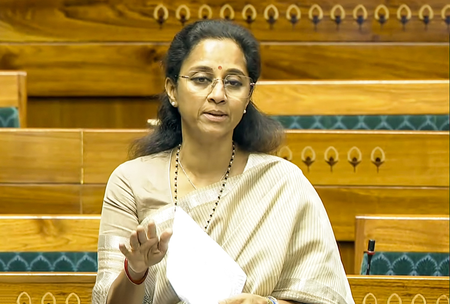
Mumbai, Nov 16 (IANS) The categorical statement by Nationalist Congress Party (Sharadchandra Pawar) working president and Baramati MP Supriya Sule on Saturday, declaring that merger talks had come to a “full stop” following the tragic death of her brother Ajit Pawar in January this year, and ruling out any possibility of joining the BJP-led NDA, marks a decisive turning point in Maharashtra politics.
With personal ties severed and the two factions aligned with opposing national alliances, the two wings of the Nationalist Congress Party (NCP) now face distinct challenges in sustaining their political relevance, expanding their support base and securing their future in Maharashtra politics.
Having rejected both reunification with the ruling faction and alignment with the National Democratic Alliance (NDA), the NCP (SP) has chosen ideological consistency over immediate access to state power. The Sharad Pawar-led faction is expected to focus more now on its consolidation as the principal Opposition anchor in Maharashtra.
With eight Lok Sabha MPs — far outnumbering the rival faction’s lone MP—NCP–SP holds significant leverage in Delhi and within the Maha Vikas Aghadi (MVA).
By staying firmly in the Opposition, Sule has avoided triggering an internal revolt from younger leaders like Rohit Pawar, who had reportedly threatened to join the Congress if NCP–SP aligned with the Bharatiya Janata Party (BJP).
However, with only 10 MLAs in the Maharashtra Assembly and the next Assembly elections years away, keeping ground-level cadres motivated without state patronage or development funds is notoriously difficult in Western Maharashtra’s cooperative-driven politics.
Former Maharashtra deputy chief minister Ajit Pawar was the undisputed organisational engine of the rival faction. Without his direct grip over local sugar cooperatives, district banks, and municipal bodies, NCP–SP can target second-rung leaders and disgruntled MLAs in the Sunetra Pawar camp who feel sidelined by senior leaders like Praful Patel or Sunil Tatkare.
Poaching the sitting MLAs may invite immediate retaliation from the BJP-led state machinery, including investigative agency scrutiny and financial squeezes on cooperative institutions.
At 86, Sharad Pawar’s active campaigning bandwidth is naturally limited. Sule’s firm “no” to a merger establishes her independent authority, signalling to cadres that she is not looking for a crutch from the ruling faction to inherit her father’s political legacy.
She can position herself as a policy-focused national parliamentarian while empowering Rohit Pawar and Jayant Patil to handle state-level street agitation. Over the medium term, if sustaining a standalone regional party without the “Clock” symbol becomes resource-heavy, NCP (SP) could explore closer structural integration—or even a future merger—with the Congress, returning to its pre-1999 roots.
As far as the ruling NCP faction is concerned, Sule’s statement closes off an easy path to regaining emotional legitimacy among traditional Pawar loyalists. Operating without Ajit Pawar’s charismatic mass appeal, Sunetra Pawar and senior leaders face acute strategic choices.
Sunetra Pawar holds the dual positions of Maharashtra Deputy Chief Minister and national president of the NCP. The party may have to explore an option of transition from a one-man command structure (Ajit Pawar) to a collective leadership model where Sunetra Pawar serves as the unifying Pawar surname and empathetic face, while the party working president Praful Patel manages Delhi equations, the Maharashtra unit chief Sunil Tatkare handles state organisation, and senior minister Chhagan Bhujbal anchors the Other Backward Class (OBC) outreach.
However, recent setbacks in the October 2026 Maharashtra Legislative Council (MLC) polls (where the party nominee lost to NCP (SP) in the Aurangabad graduates constituency) indicate that transferring Ajit Pawar’s personal vote bank seamlessly to a new leadership setup is proving challenging.
With 41 MLAs in a comfortable Mahayuti government, the NCP does not face an immediate existential threat. It can use ministerial portfolios, Guardian Ministerships (such as Pune and Beed), and state funds to keep its MLAs satisfied and ring-fence its Western Maharashtra bastions ahead of local body and civic polls.
But the over-dependence on the BJP may reduce the party’s autonomous identity. As seen in Chief Minister Devendra Fadnavis’s remarks that the BJP would expect to be consulted on any merger, the BJP treats the NCP as a junior partner whose seat share in future elections could be trimmed if its independent vote transfer weakens.
If a formal party-to-party merger is off the table, the ruling NCP can still weaken NCP (SP) incrementally by inducing individual MLAs or local strongmen from Sharad Pawar’s camp to cross over, citing constituency development funds and three more years of Mahayuti rule. However, bringing in outsiders could trigger friction among its own 41 MLAs over ticket distribution and cabinet berths, said the party insiders.
As long as NCP’s identity revolves around being the “other Pawar faction,” it remains vulnerable to comparisons with Sharad Pawar’s original legacy. Sunetra Pawar has already signalled a shift towards issue-based positioning — such as focusing on artificial intelligence (AI) and modern technology in agriculture and party introspection.
Carving out a distinct social coalition (Maratha-OBC-minority balance within the NDA) is essential to survive independently of the Baramati family dynamic.
The political observers argued that a permanently divided NCP prevents either faction from recreating the undivided NCP’s 55–70 seat dominance in Maharashtra. In Western Maharashtra, the BJP gains room to expand into traditional sugar-belt constituencies, while the Congress becomes the primary beneficiary of anti-BJP votes within the MVA.
For voters and party workers, the biggest fallout of Sule’s announcement is clarity. Since January 2026, persistent rumours of a reunion kept cadres in both camps hesitant to attack each other aggressively. With reunification formally buried, both factions will have to now fight each other as permanent political rivals.
Sanjay Jog can be contacted at sanjay.j@ians.in
–IANS
sj/snj
About the Author