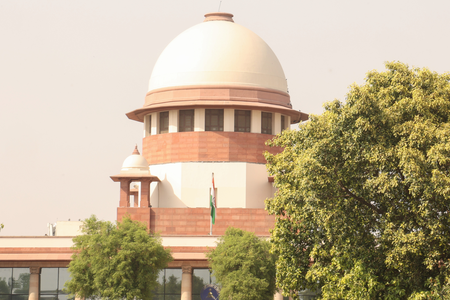
New Delhi, Aug 31 (IANS) The Supreme Court on Monday refused to entertain a public interest litigation (PIL) seeking directions for disclosure of the ethanol content in petrol and greater transparency regarding the compatibility of ethanol-blended fuel with vehicles.
A Bench of Justices M.M. Sundresh and Prasanna B. Varale declined to entertain the plea filed by advocate N.K. Goswami, while granting him liberty to approach the concerned High Court with his grievance.
“Go to HC and file it,” the Justice Sundresh-led Bench told Goswami.
The petitioner-in-person submitted that he was not challenging the Centre’s ethanol-blending policy but was only seeking disclosure of the ethanol content in petrol being sold to consumers. “I am not challenging the policy. I just want to know. I have the right to know. Even when we buy a packet of biscuits we know the ingredients,” Goswami argued.
He further submitted that the issue concerned the rights of citizens and not any personal benefit. “We have the right to know what we are purchasing,” he told the apex court.
Attorney General for India, R. Venkataramani, objected to the manner in which the matter was being pursued, saying, “He (Goswami) wants the Government of India to be answerable to him!”
AG Venkataramani, the highest law officer of the Centre, also described the petition as a “proxy petition” and pointed out that the Supreme Court had dismissed a similar plea last year.
The Justice Sundresh-led Bench ultimately declined to entertain the matter and left it open to the petitioner to seek appropriate relief before the High Court.
The PIL had sought directions requiring every petrol dispensing nozzle and fuel invoice to disclose the percentage of ethanol in the fuel being sold. It also sought publication of an official vehicle-wise compatibility database and a transparent transition framework for legacy vehicles that may not be compatible with higher ethanol blends.
The petition further sought safeguards against warranty, insurance or service-related prejudice to vehicle owners where the government had not provided an alternative fuel option, besides seeking constitution of an independent expert committee to examine the wider ramifications of the ethanol-blending programme.
The petitioner had argued that the plea did not seek to question the wisdom of ethanol blending or halt the country’s march towards energy self-reliance. “The policy, as a policy, stands unchallenged,” the petition stated, adding that the matter concerned the “constitutional validity of a silent, unconsenting compulsion visited upon millions of citizens”.
It contended that consumers were being made to purchase and use fuel without knowing its exact composition, without access to authoritative information regarding compatibility with their vehicles and without any realistic alternative.
The plea argued that while the government could encourage, persuade and incentivise citizens in pursuit of a policy objective, it could not, through lack of disclosure and absence of choice, compel them to subject their vehicles to an unknown risk.
The petitioner, who owns a 2018 Honda BR-V petrol vehicle, said his vehicle was designed and sold years before E20 was notified as an automotive fuel. He claimed that when he visits a petrol pump, he is offered fuel whose ethanol content is not disclosed to him and that he has no genuine option to purchase a lower-ethanol blend.
The petition said the concerns had assumed significance following the widespread introduction of E20 petrol, particularly for owners of older vehicles.
According to the petition, the NITI Aayog’s “Roadmap for Ethanol Blending in India 2020-25”, released in June 2021, contemplated a phased transition and envisaged continued availability of lower-ethanol fuel for older vehicles.
It stated that the Union Ministry of Road Transport and Highways notified standards concerning E20 as automotive fuel on March 8, 2021, while the Bureau of Indian Standards issued E20 fuel specifications in 2022 for “suitably compatible vehicles”.
The petition further pointed out that the rollout of E10-tuned and E20 material-compliant vehicles began from April 1, 2023, while E20 engine-tuned vehicles began to be rolled out from April 1, 2025.
The plea claimed that E20 petrol was widely introduced across the country in 2025, substantially replacing lower-ethanol blends at the point of sale.
The petitioner claimed that persistent concerns had emerged over the absence of adequate pump labelling, invoice information, vehicle compatibility data and alternatives for owners of non-compatible vehicles.
The plea also referred to a representation submitted by Goswami to the Secretary, Ministry of Petroleum and Natural Gas, on July 4, seeking measures relating to disclosure, compatibility and consumer choice, but alleged that no satisfactory corrective action followed.
The latest proceedings come nearly a year after the Supreme Court dismissed a similar PIL challenging the Centre’s “unregulated” rollout of E20 petrol as the default petrol.
On September 1, 2025, a Bench headed by then Chief Justice of India (CJI) B.R. Gavai and Justice K. Vinod Chandran dismissed the plea, which had argued that mandating E20 for a predominantly non-compatible vehicle fleet, particularly pre-April 2023 models, could lead to material degradation, safety risks, mileage loss and warranty and insurance disputes.
The 2025 plea had contended that mandating E20 amounted to arbitrary action in violation of Articles 14, 19(1)(g), 21 and 300A of the Constitution, particularly in the absence of phased conformity, safeguards and alternatives at retail outlets.
Opposing that petition, Attorney General R. Venkataramani had described the litigant as a “name-lender” and argued that a lobby was driving the litigation.
AG Venkataramani had also submitted that “outsiders” should not be allowed to decide what class of petrol is used, while highlighting the benefits of ethanol blending for sugarcane farmers.
The Centre has maintained that E20 petrol provides better acceleration and ride quality and has helped lower carbon emissions by approximately 30 per cent compared to E10 fuel.
The government has also cited Brazil’s experience with higher ethanol blends, stating that the country has been successfully running on E27 and that the same automakers, including Toyota, Honda and Hyundai, manufacture vehicles there.
The government has maintained that the ethanol-blending programme advances energy security, boosts farmers’ incomes and contributes to environmental sustainability.
–IANS
pds/dpb
About the Author