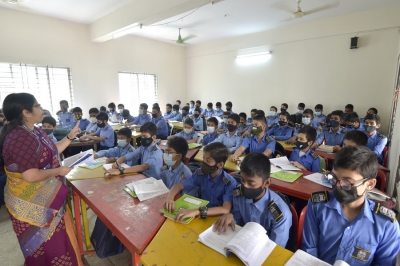
Dhaka, July 18 (IANS) The roots of Bangladesh’s youth employment crisis lie well before young people enter the labour market, with an education system failing to equip students with quality learning and job-ready skills, a report has stated.
Public spending on education has remained below 2 per cent of GDP — far below UNESCO’s recommended 4–6 per cent and the lowest in the Asia-Pacific region. The impact is reflected in poor learning outcomes, with only 49 per cent of children aged 7–14 possessing basic reading and numeracy skills, limiting their employability later in life, according to a report in Bangladesh’s leading newspaper, The Daily Star.
“Bangladesh is now home to more than 17.5 crore people. Roughly one in four is 15-29 years of age, a cohort of around 4.7 crore, larger than the population of many countries. More than half the population is below 25, and the median age is about 27, against a global median of roughly 31. Close to 20 lakh young Bangladeshis reach working age each year, and most will not find the work they trained for,” the report detailed.
“Many prioritise taking government job exams until they reach the cutoff age (32 years), then turn to the private sector or simply leave. This arithmetic is central to this year’s World Population Day, themed ‘Realising the hopes and aspirations of young people—today and for the future.’ For Bangladesh, this theme lands as an unanswered question,” it added.
The report said the education system in Bangladesh places greater emphasis on memorisation than critical thinking, while collaboration with industry remains weak. Consequently, many Higher Secondary Certificate (HSC) graduates have learning outcomes comparable to international Grade 7 standards and are ill-equipped for the demands of the Fourth Industrial Revolution.
“As such, tertiary-educated unemployment rose from 9.7 per cent in 2013 to 27.8 per cent in 2022, even as overall unemployment stayed in the low single digits. Nearly one in five young people is not in employment, education or training (NEET), with the rate reaching almost 40 per cent among those aged 15 to 24, nearly twice the global average. This reflects a labour market built on contradiction,” it added.
Emphasising that for a significant section of Bangladesh’s youth, the preferred response is not resistance but migration, the report said, “Around 55 per cent of young Bangladeshis want to migrate, citing fairer opportunities and a more predictable future. The stock of Bangladeshis living abroad rose by 71.5 per cent between 1990 and 2024, from 50.8 lakh to 87 lakh, now about 5 per cent of the total population.”
According to the report, gender and geography further deepen these challenges. Bangladesh continues to record the highest child marriage rate in Asia, with 51 per cent of women married before the age of 18, while also having one of the world’s highest adolescent pregnancy rates outside Sub-Saharan Africa.
The report noted that urban female labour force participation declined from 31 per cent in 2016 to 25 per cent in 2023. At the same time, more young women are choosing migration over early marriage or low-paid informal work—a significant shift from a generation ago, when migration was largely a male phenomenon. It also highlighted that young people remain largely excluded from decision-making, leaving those most affected with little influence over the policies that shape their future.
–IANS
scor/ksk/as
About the Author