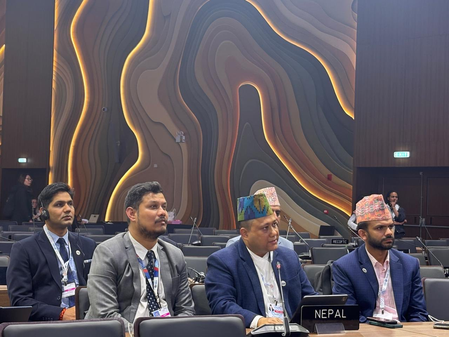
Kathmandu, Nov 10 (IANS) Nepal’s Foreign Minister Shishir Khanal has urged the international community to prioritise three key measures to address the growing impacts of climate change on mountain regions, highlighting the devastating floods that hit Nepal on August 26 as evidence of the country’s vulnerability.
He called for ensuring the 1.5 degrees Celsius warming limit for the Himalayas, establishing a dedicated work programme on mountains and climate change, and incorporating mountain-specific indicators into global climate finance and adaptation frameworks.
Addressing the opening session of the 31st Conference of the Parties (COP31) to the United Nations Framework Convention on Climate Change (UNFCCC) on Monday (local time) in Turkey, Khanal said concrete international commitments and effective implementation were essential to protecting the Himalayan region and mitigating the impacts of climate change.
Khanal’s call for mountain-specific measures comes at a time when devastating floods along the Bhote Koshi and Trishuli rivers on August 26 killed more than 1,400 people, while over 5,000 remain unaccounted for.
The floods also caused extensive damage to public and private property, estimated at 1.66 billion US dollars, according to the World Bank. Human settlements, a dozen hydropower projects, a solar power project, roads and buildings suffered extensive damage.
An avalanche blocked a tributary of the Bhote Koshi River near the Nepal-China border, creating a natural dam that subsequently burst and triggered devastating floods downstream along the Bhotekoshi and Trishuli rivers.
Recovery and reconstruction needs following the disasters are estimated at more than 4.77 billion US dollars, according to the Rapid Disaster Needs Assessment report prepared by Nepali government agencies.
Khanal also drew the international community’s attention to the devastating climate-related disasters Nepal has experienced in recent months.
“On 26 August, mountain collapse unleashed what we have called a Himalayan Tsunami,” he said, adding that more than 1,400 people had lost their lives, while over 5,000 remained missing.
Critical infrastructure was swept away within minutes, and the cost of rebuilding was estimated at around one-tenth of Nepal’s entire economy, he said, adding that scientific evidence confirmed the role of climate change in the disaster.
Nepal experienced three major disasters between August and October alone, he said.
Khanal said Nepal had received widespread sympathy from the international community following the disasters but stressed the need to translate that support into concrete action.
“Now is the time to turn sympathy into systems and commitments into implementation,” he said.
In recent years, major infrastructure projects in Nepal, including the multimillion-dollar Melamchi Drinking Water Project, which aims to supply water to the Kathmandu Valley, as well as several hydropower projects, have suffered repeated damage from devastating floods and landslides.
These incidents have raised concerns about the growing economic costs of climate change for the country.
Following the latest disasters, Nepal has been calling for climate justice, arguing that the country has contributed negligibly to global climate change despite suffering disproportionately from its impacts.
“We come here seeking climate justice,” Khanal said, stressing that the Himalayan region, despite contributing negligibly to global greenhouse gas emissions, is melting at an alarming rate.
He said the Himalayas sustain the lives and livelihoods of around one-third of humanity, while mountain regions cover approximately 27 per cent of the world’s land area and are home to 15 per cent of its population.
Khanal said Nepal remained committed to working with international partners to protect mountain communities, strengthen climate adaptation and advance climate justice. He called on all countries participating in COP31 to demonstrate strong solidarity with Nepal and mountain communities worldwide.
Khanal also highlighted Nepal’s efforts to pursue climate-friendly development, noting that nearly half of the country’s land area is covered by community-conserved forests, its energy generation relies on hydropower, and more than 70 per cent of newly purchased consumer vehicles are electric.
–IANS
scor/sd/
About the Author