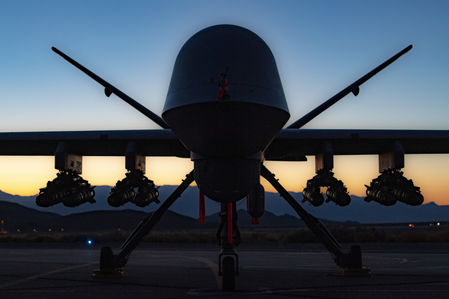
Washington, May 22 (IANS) The US Air Force’s MQ-9 Reaper drones emerged as one of the most heavily used platforms during recent operations linked to Iran, senior Air Force officials told lawmakers this week, describing the unmanned aircraft as a critical force multiplier in combat missions across the Middle East.
Speaking before Congressional committees this week, Air Force Chief of Staff General Kenneth Wilsbach said the MQ-9 had played a major operational role during Operation Epic Fury, underlining the growing importance of unmanned systems in modern warfare.
“For Epic Fury, perhaps maybe the most valuable player was unmanned and that’s the MQ-9,” Wilsbach told lawmakers during a hearing of the House Armed Services Committee.
“We’ve made many, many strikes. I don’t want to say how many because the number’s classified, but no other platform is even close to the MQ-9.”
The comments came as the Department of the Air Force defended its proposed FY2027 budget before both the House and Senate Armed Services Committees amid growing debate in Washington over future air combat strategy, unmanned systems and readiness.
Wilsbach said the MQ-9 provided “a lot of utility” while reducing risks to pilots and crews.
He added that unmanned systems were becoming increasingly central to US military operations, although he cautioned that fully autonomous combat aviation was still some distance away.
Air Force Secretary Troy Meink also told lawmakers the service was not retiring the MQ-9 fleet despite broader force modernisation plans. Instead, the Air Force was looking at future successor systems that could operate alongside manned fighters and other autonomous aircraft.
“We are not divesting the MQ-9,” Meink said during the Congressional hearing.
“We are looking at what is the follow-on to the MQ-9 aircraft, and it’s probably going to be not one platform, it’ll probably be multiple platforms.”
Congressional leaders repeatedly pressed Air Force officials on the balance between costly next-generation fighter aircraft and lower-cost autonomous systems.
General Wilsbach pointed to the development of Collaborative Combat Aircraft (CCA), describing them as autonomous systems designed to operate alongside manned fighters such as the F-47, F-22 and F-35.
He said the systems were already flying and demonstrating promising capabilities.
“The autonomous systems are working,” Wilsbach told Senators.
“We’re learning from it and adjusting as we go.”
House Armed Services Committee Chairman Mike D Rogers urged the Air Force to think beyond traditional manned fighters and move towards remotely operated combat aircraft to reduce risks to pilots and lower operational costs.
The Pentagon’s proposed FY2027 budget includes $1.4 billion for Collaborative Combat Aircraft (CCA) development as part of a broader push towards autonomy, artificial intelligence and advanced battle management systems.
–IANS
int/lkj/ksk/khz
About the Author