Bengaluru, June 29 (IANS) The Special Intensive Revision (SIR) of the electoral rolls in Karnataka will commence on June 30, with 59,050 Booth Level Officers (BLOs) carrying out a month-long house-to-house verification exercise to ensure that the state’s electoral rolls remain accurate, complete and up to date.
Addressing a press conference on Monday, Chief Electoral Officer V. Anbu Kumar said the Special Intensive Revision is being undertaken following directions issued by the Election Commission of India (ECI).
Describing the exercise as participative, transparent and citizen-centric, Anbu Kumar appealed to all electors to cooperate fully with the Booth Level Officers by providing accurate information, completing and signing the Enumeration Forms, and handing them over during the visits.
He also called upon political parties, Booth Level Agents, local bodies, civil society organisations, the media and the general public to extend wholehearted support to ensure the successful completion of the revision exercise.
Karnataka is among 16 states and three Union Territories where the exercise is being conducted, with October 1, 2026, as the qualifying date, he stated.
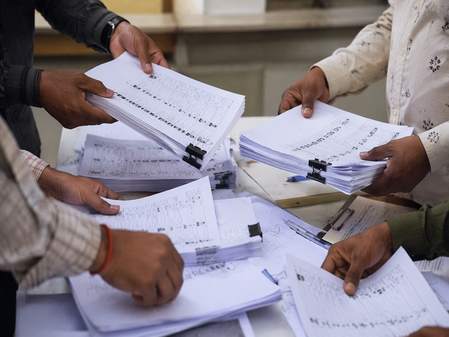
The house-to-house enumeration will be carried out from June 30 to July 29, during which Booth Level Officers will visit every household in their assigned polling areas to distribute Enumeration Forms to electors whose names appear in the electoral roll as on June 16, 2026.
The draft electoral roll will be published on August 5, followed by a one-month period for filing claims and objections until September 4. The final electoral roll will be published on October 7 after the disposal of all claims and objections.
The Chief Electoral Officer said all preparatory work for the revision has been completed. A total of 59,050 Booth Level Officers have been trained and deployed across the state.
Training has also been imparted to all 31 District Election Officers, four Additional District Election Officers, 224 Electoral Registration Officers, 336 Assistant Electoral Registration Officers and 7,556 BLO Supervisors.
In addition, 1,15,112 Booth Level Agents appointed by political parties have been deployed, with the majority already trained.
Awareness and orientation programmes have also been conducted for recognised national and state political parties, as well as representatives of the print, electronic and social media, to ensure transparency and public participation.
Karnataka currently has 5,54,32,314 registered electors, as on June 16, 2026, all of whom will be covered under the Special Intensive Revision.
During the house visits, BLOs will distribute Enumeration Forms and paste colour-coded stickers on households.
A violet square sticker will indicate that the Enumeration Form has been distributed, while a red circular sticker will indicate that the house was found locked during the visit.
After electors fill in and sign the forms, the BLOs will collect them for digitisation.
To ensure maximum participation, BLOs will make at least three visits to households wherever necessary to collect the completed forms.
The Chief Electoral Officer clarified that no supporting documents will be collected during the house-to-house enumeration phase.
Electors who submit the duly completed Enumeration Form within the prescribed period will be included in the draft electoral roll. Those who fail to submit the form will not be included in the draft roll.
Electors will also be able to fill in and submit the Enumeration Forms online through the Voters’ Service Portal and the ECINET mobile application from June 30.
Citizens who have recently become eligible to vote can apply for inclusion in the electoral roll by submitting Form 6 along with the prescribed declaration form in accordance with the Election Commission’s guidelines.
The digitisation of all Enumeration Forms and the entire house-to-house enumeration process will be completed by July 29.
To create public awareness, rallies, Prabhat Pheris and other outreach programmes will be organised across districts and Assembly constituencies.
The Office of the Chief Electoral Officer has also made available circulars, guidelines, videos, FAQs, training materials and other reference documents relating to the Special Intensive Revision through a dedicated public online repository for the benefit of electors and other stakeholders, he said.
–IANS
mka/pgh
About the Author