
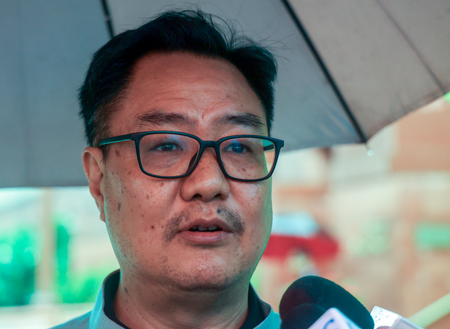
New Delhi, Aug 19 (IANS) Union Parliamentary Affairs Minister Kiren Rijiju on Wednesday dismissed the allegations made by Lok Sabha Leader of Opposition (LoP) Rahul Gandhi regarding alleged Chinese intrusion into Indian territory, asserting that the concerns being raised in Arunachal Pradesh need to be viewed in the context of the long-standing lack of a formally demarcated India-China boundary.
Rijiju said the situation has been complicated by the absence of clearly marked borders and accused previous Congress-led governments of following a policy that discouraged infrastructure development on the Indian side of the frontier.
His remarks came in response to Rahul Gandhi’s repeated allegations that the Centre has concealed Chinese incursions and failed to adequately protect India’s territory.
Rejecting the claims, Rijiju said such statements could create confusion and should not be made without understanding the ground situation.
In an interview with IANS, Rijiju said, “Such statements should not be made. There are issues in several places in Arunachal Pradesh; the root cause of these issues needs to be understood. India and China share a very long border in Arunachal Pradesh that has not been formally delineated. There are no border pillars, and the boundary is not clearly marked on the ground; there is no distinct border line. This is not a recent issue. Even when Tibet was a separate entity, the border between Tibet and India had not been delineated.”
The Union Minister said that concerns among residents living in the border areas were genuine because of the absence of proper demarcation, but maintained that presenting the issue through unverified videos and claims could mislead the public.
“It is wrong for people to spread confusion by sharing various videos. There is indeed an issue regarding the border. Some villagers in Arunachal Pradesh have expressed concerns about the border, and rightly so, because the boundary has not been delineated there,” he said.
Rijiju further explained that the rugged terrain of the region had historically limited permanent habitation, as several such areas were traditionally used for hunting and grazing rather than settlements.
“Due to the absence of delineation, there have been long tensions between India and China,” he said.
According to Rijiju, the “core issue” is also connected to the pace of infrastructure development along the border. He alleged that China began building roads and other infrastructure much earlier, while the Congress-led governments at the Centre followed a different approach.
Taking aim at the previous UPA governments, Rijiju said, “At that time, the Congress was in power in India. A.K. Antony, the then Defence Minister under the Congress government, stated in Parliament that it was the government’s policy not to build infrastructure on the Indian side. Meanwhile, China continued to develop infrastructure steadily.”
The Union Minister claimed that the situation began changing after 2014, when the Narendra Modi-led NDA government came to power and placed greater emphasis on developing roads and connectivity in strategically important border areas.
“PM Modi changed the policy, and roads are now being constructed on our side as well. I personally visited Maza, a village located at the last border point. I met with border force personnel and soldiers there. The road construction work was completed. No road had been built at the border in all the years since 1947; under PM Modi’s leadership, we got the road constructed,” he said.
Rijiju also referred to the road connectivity to Taksing, saying that infrastructure development had been taken up to improve access to remote areas along the frontier.
“We previously lacked a road connection. PM Modi had the road to Taksing built in 2019. Because we lacked a road while China had built one, the Chinese army occupied certain high-altitude areas and constructed border infrastructure; we are now responding by building our own infrastructure,” he said.
At the same time, Rijiju rejected the suggestion that China had occupied Indian villages, explaining that certain disputed stretches remain affected by the absence of a clearly demarcated boundary.
“It is not the case that they have occupied any of our villages. They have set up camp on a certain stretch of land because the boundary there is not demarcated. Our people believe our territory extends further, whereas the locals there claim the land belongs to them,” he added.
Rijiju also said that patrolling by the Indian Army and the Indo-Tibetan Border Police (ITBP) has been strengthened in sensitive areas along the frontier. He referred to a location beyond Longju where Chinese forces have established structures, saying the area had been under Chinese control for several decades.
“Regarding the village that has been established, located in a valley beyond Longju, the Chinese PLA has constructed some structures and buildings resembling a village. That land was occupied in 1959, and they further consolidated their hold over it in 1962,” he said.
He acknowledged increased Chinese military activity along the ridgeline and said the concerns expressed by local residents need to be taken seriously.
“We have a post at the current border point. While there is no cross-border movement between India and China at that specific location, Chinese military activity has certainly increased along the ridgeline. This has heightened the concerns of our villagers, and we must take their apprehensions seriously,” he added.
Rijiju also accused the Congress of using misleading material to build a political narrative around the border issue.
“However, spreading such narratives by circulating a fake video, purportedly from Bangladesh, is wrong. Doing so undermines the morale of the armed forces,” the Union Minister said.
–IANS
sd/uk
About the Author


