Bengaluru, Oct 19 (IANS) Karnataka Chief Minister, D.K. Shivakumar, has written to Prime Minister Narendra Modi seeking urgent intervention to address the demands of sugarcane farmers, as protests in North Karnataka have delayed the commencement of the crushing season.
In his three-page letter on Monday, CM Shivakumar urged the Centre to take early decisions on five key demands, including revision of the Minimum Selling Price (MSP) of sugar, separate prices for domestic and commercial sugar, changes in cane-based ethanol procurement and pricing, and restoration of the base recovery rate for fixing the Fair and Remunerative Price (FRP) at 9.50 per cent.
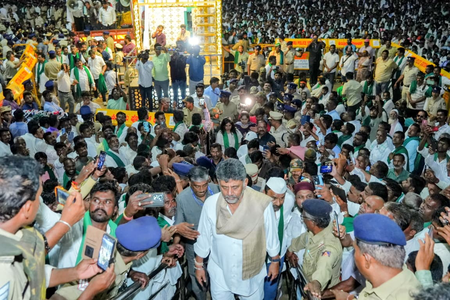
Sugarcane farmers in North Karnataka have been protesting at various places and undertaking padayatras from different towns towards Hubballi, intending to gherao the residence of Union Minister Pralhad Joshi. Road blockades have also been reported at several locations.
The Karnataka High Court has issued directions restraining the proposed protest at Joshi’s residence.
CM Shivakumar said he visited Kittur in Belagavi district on October 17 and appealed to the protesting farmers to call off their padayatra. However, the farmers maintained that their principal demands fell within the Centre’s purview and that they would not withdraw the agitation without an assurance from the Union government.
Describing the situation as grave, CM Shivakumar said the crushing season had not commenced in North Karnataka, leaving mature sugarcane standing in fields.
Every day of delay was resulting in losses in cane weight and sugar content, he said. The continuing road blockades were also disrupting public order and causing considerable hardship to the general public.
The Chief Minister said the state government had taken all measures available within its powers to address the concerns of farmers.
Under a government order dated November 27, 2023, the Legal Metrology Department had issued a Standard Operating Procedure to prevent irregularities in sugar mill weighbridges, and all mills had been directed to comply.
All 81 operational mills had shifted from analogue to digital load cells. District-level teams had also been constituted to inspect sugar recovery and cane weight at every mill at least twice a month during the 2025-26 season and submit reports to the state government.
These measures had helped increase average sugar recovery from 9.91 per cent in 2022-23 to 11.09 per cent in 2025-26. All mills had also been directed to obtain accreditation from the National Accreditation Board for Testing and Calibration Laboratories (NABL) for their recovery-testing laboratories.
CM Shivakumar said the state had ensured an additional Rs 100 per tonne over and above the price agreed upon by mills for the 2025-26 season through Government Order. The state government had borne Rs 50 per tonne of this additional amount from its own funds, and around Rs 290 crore had been paid directly to farmers.
However, he said the farmers’ core demands could be addressed only by the Centre. Karnataka welcomed the committee constituted by the Union government on October 14 under the chairmanship of former NITI Aayog member Ramesh Chand to examine issues concerning sugarcane farmers and the sugar sector.
The state would participate fully and share its data, CM Shivakumar said, adding that urgent decisions were necessary even as the committee continued its work.
Among the key demands, CM Shivakumar sought revision of the sugar MSP, which has remained at Rs 31 per kg since February 14, 2019, despite the FRP increasing from Rs 2,750 to Rs 3,650 per tonne. He said mills could not pay farmers a fair price for sugarcane when the price of sugar remained at its 2019 level.
He also sought separate MSPs for domestic and commercial sugar to protect household consumers while ensuring that bulk commercial buyers paid a fair price.
The Chief Minister urged the Centre to review the exclusion of ethanol produced from sugarcane juice, sugar syrup and B-heavy molasses from the procurement tender issued by oil marketing companies on October 16 for the Ethanol Supply Year 2026-27, covering November 2026 to October 2027. Ethanol produced from C-heavy molasses remained eligible under the tender.
Karnataka has a cane-based ethanol production capacity of 225 crore litres annually. Shivakumar said excluding these feedstocks could adversely affect sugar mills’ revenue and constrain their ability to make timely payments to farmers. He sought a review of the decision and a fair allocation for cane-based ethanol production in proportion to mills’ installed capacity.
He further sought revision of ethanol prices for products made from sugarcane juice and B-heavy molasses, which had remained unchanged since 2022-23 despite annual increases in the FRP payable for sugarcane. In contrast, prices of grain-based ethanol had been revised upwards over the years.
Another demand was the restoration of the FRP base recovery rate to 9.50 per cent from the current 10.25 per cent. Shivakumar said the base recovery rate had been increased in stages and that FRP was reduced when recovery fell below the prescribed level.
He argued that sugar recovery depended on soil, climate and the timing of crushing, factors beyond farmers’ control. Consequently, farmers in low-recovery areas were unable to receive even the base FRP.
CM Shivakumar urged PM Modi to intervene urgently, saying a clear and timely announcement on the demands would help the state government persuade farmers to withdraw their agitation and allow the crushing season to begin without further delay. He said an early decision was necessary in the interests of lakhs of sugarcane farmers and the people of Karnataka.
–IANS
mka/rad
About the Author