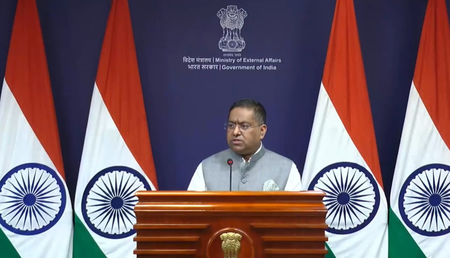
New Delhi, Aug 7 (IANS) India on Friday rejected comments made by a section of the international community, including a US lawmaker, on the Foreign Contribution (Regulation) Act Amendment (FCRA) Bill, stressing that legislative matters concerning India are internal affairs of the country on which decisions are taken by the Parliament.
Addressing a bi-weekly media briefing in New Delhi on Friday, Ministry of External Affairs (MEA) spokesperson Randhir Jaiswal noted that several nations, including the United States (US), regulate the flow of foreign funds.
“We have seen the comments; legislative matters concerning India are our internal affairs on which decisions are taken by the Parliament of our country. I would also like to point out that there are several nations, including the United States, which regulate the flow of foreign funds,” said Jaiswal while responding to a media query.
US lawmaker Riley Moore had recently commented over the amendments proposed by India to its laws governing foreign donations.
The Central Government is likely to introduce FCRA in the Lok Sabha during the ongoing Monsoon Session of the Parliament.
With the rapid expansion of global financial networks, digital transactions and transnational funding mechanisms have created new governance challenges relating to financial transparency, foreign influence and protection of democratic institutions. Consequently, regulation of foreign financial flows has emerged as an accepted feature of modern governance in many democracies, according to an official statement issued on July 22.
“The Foreign Contribution (Regulation) Act (FCRA) should therefore be understood within this wider international context. Rather than restricting legitimate charitable activities, the Act provides a legal framework that enables genuine international cooperation while ensuring that foreign contributions are received, utilised and accounted for in accordance with Indian law,” the Indian government has noted.
The FCRA is the law that governs how Indian individuals, associations, NGOs, trusts and companies may receive and use money, securities or articles sent to them from a source outside India. It is administered by the Ministry of Home Affairs (MHA).
In plain terms, FCRA does three things: It identifies who may accept foreign contributions, and on what conditions. It specifies how that money must be received, accounted for, and reported. And thirdly, it restricts a narrow, defined set of foreign-funded activities that could affect India’s sovereignty, security or public order.
According to the government, Canada’s Foreign Influence Transparency and Accountability Act, enacted in 2024, records in its preamble a ‘growing consensus in Canada and among its allies that foreign influence registries are a necessary tool to lessen foreign interference in the affairs of state.’ India has maintained a comparable framework since 1976.
Similarly, the United States, the original author of this model, has in 2025 directed federal agencies to enforce its 87-year-old FARA (Foreign Agents Registration Act) more assertively, not less.
The European Union’s proposal followed a Eurobarometer survey in which 81 per cent of Europeans called covert foreign interference a serious problem.
The United Kingdom’s Foreign Influence Registration Scheme, National Security Act 2023 came in force from July 1, 2025.
India’s FCRA, the government maintains, sits comfortably within this global family of frameworks. Several of these foreign-influence laws were enacted or significantly strengthened in recent years. This direction of travel, toward more transparency rather than less, reflects a broad democratic consensus.
“Democracies increasingly require transparency where foreign money, direction or institutional relationships may affect domestic public processes, and they provide sanctions for concealment or non-compliance,” the government has stated.
–IANS
akl/as
About the Author