
New Delhi, Sep 8 (IANS) Closure of land routes, costly air freight, limited alternative routes are all adding to the woes of Afghan exporters struggling to send out their wares to the global markets, say reports from Kabul.
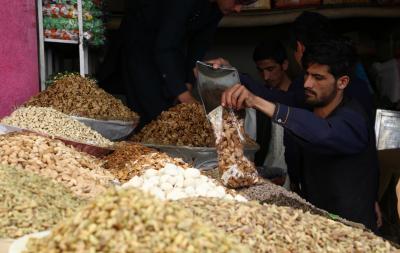
Therefore, to ensure smooth import, a group of Indian traders who have travelled to Kandahar to purchase dried fruit now intend to export Afghan dried fruit to New Delhi through alternative routes, Tolo News reported.
Kandahar’s growers said that the province’s well-known golden raisins were previously exported to India, but that route now remain closed, the report added on Sunday.
The “golden” variety, locally known as Abjosh raisins, are made from a grape called Aita.
Farmers dip the grapes in a special solution before spreading them out on prepared grounds for seven days to produce golden raisins.
Much of Kandahar’s fresh and dried fruit is exported to neighboring, Arab and European countries, but the recent increase in air freight costs has raised concerns among dried-fruit traders.
One of the traders from India, identified as Anand, told the Afghan news website, “We have been here for three or four days buying dried fruit, and then we send it to New Delhi through other Asian countries. This is our trade with Afghanistan.”
Official figures earlier suggested that the closure of the Pakistan border on one side and the geopolitical conflicts in West Asia on the other, are affecting Afghanistan’s global trade.
Separate reports quoted data showing that Afghan traders began relying on Iran’s Chabahar Port, expanded rail corridors through Uzbekistan and Turkmenistan, and air freight links to India, as alternative routes.
These alternatives provide resilience but at higher costs and with geopolitical risks.
India remains one of Afghanistan’s largest trading partners, with bilateral trade reaching $907.85 million in 2025–26 despite Pakistan’s route closures.
India mainly imports dry fruits, saffron, and spices, while exporting pharmaceuticals, machinery, and food products.
But now, with the war in West Asia and climbing costs in air freight have further affected traders.
Even before the Pakistan-Afghanistan conflict turned deadly last year, leading to the closure of trade routes at the Durand Line, Islamabad created blockages for goods coming from India, meant for Afghanistan. Thus, it was through the Chabahar Port and air corridors that kept commerce alive despite Pakistan’s blockades.
Despite Islamabad’s strained relation with earlier governments in Kabul, container traffic increased from about 60,500 containers in 2016-2017 to nearly 89,000 containers in 2020-2021, just before the Taliban returned to power, reports said quoting Pakistan Customs data.
Following the Taliban’s return to power, transit cargo via Pakistan initially recovered, with container traffic reaching 102,886 and cargo valued at $6.7 billion in 2022-2023.
However, this marked the peak before the volume declined to 42,959 containers worth $1.36 billion in 2024-2025, reports added.
In October 2025, the Afghanistan-Pakistan border was closed following a fierce skirmish.
According to the Customs figures, the number fell to just 11,592 containers worth $367 million in 2025-26.
Afghanistan’s exports via Pakistan to India and other countries dropped from $454 million in 2024-2025 to $7 million in 2025-2026, these reports added.
–IANS
jb/khz
About the Author


