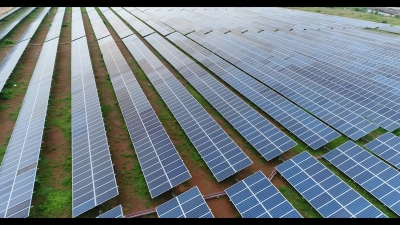
New Delhi, May 10 (IANS) India now ranks third globally on installed renewable energy capacity and the effectiveness of the renewable transition in improving macro resilience will depend on the success of industrial policy in localising upstream segments like solar cells over time, according to a new report.
Renewable energy is the central pillar of India’s medium-term strategy to structurally reduce external energy dependence, according to a Morgan Stanley report.
Domestic module manufacturing capacity has expanded rapidly, supported by PLI schemes and customs duties. Recent data from MNRE suggests a sharp uptick in domestic solar manufacturing capacity, with module capacity rising from 38 GW in March 2024 to 74 GW in March 2025 and cell capacity from 9 GW to 25 GW in the same period.
“However, in upstream segments, such as solar cells, wafers and polysilicon, India’s renewable deployment remains partly reliant on imported components. In FY2025, India imported approximately 35 million solar modules valued at around $1.6 billion, with an estimated 60-80 per cent of these imports sourced from China,” said the report.
While renewable transition reduces fossil fuel dependence, it doesn’t eliminate external exposure linked to manufacturing supply chains.
While deployment capacity has scaled quickly, upstream manufacturing capabilities have not kept pace. As a result, a meaningful portion of the solar ecosystem remains exposed to external supply chains, especially from China, said the report.
Non-fossil installed capacity has now crossed 50 per cent of total capacity, touching 262.7 GW in November 2025, with solar (132.9 GW) and wind (54GW) accounting for the bulk of incremental additions, according to a Morgan Stanley report.
The government’s 2030 NDC target calls for 500 GW of non-fossil capacity, and India achieved 50 per cent non-fossil capacity five years earlier than anticipated, supported by a combination of utility-scale expansion, distributed generation schemes (such as PM Surya Ghar and PM-KUSUM) and continued policy support for grid integration.
“From a macro standpoint, the expansion of renewables directly compresses the import intensity of growth, as every incremental unit of domestic solar and wind reduces the economy’s sensitivity to imported fossil fuels,” said the report.
—IANS
na/
About the Author