Gandhinagar, Sep 24 (IANS) Prison officers from 12 states are being trained to identify psychological and behavioural risks among inmates, including suicide and self-harm risks, under a national capacity-building programme launched by Rashtriya Raksha University (RRU) in Gujarat.
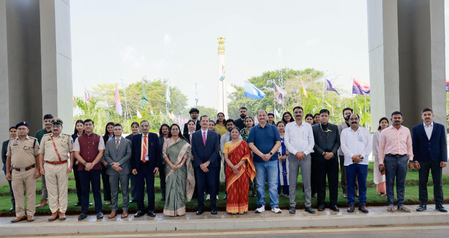
RRU is hosting a three-day residential “National Training of Trainers on Correctional Mental Health under Project PRAHARI” from September 23 to 25, bringing together Superintendents of Police, Additional SPs, Deputy SPs and jailers from prison and correctional services across 12 states, including Andhra Pradesh, Gujarat, Jharkhand, Karnataka, Kerala, Maharashtra, Odisha, Tamil Nadu, Uttar Pradesh, Punjab and Uttarakhand.
PRAHARI, or Psychological Risk Assessment, Health Awareness and Resilience Initiative, is a capacity-building programme of RRU’s Global Correctional Administration Studies (GCAS).
It is designed to equip frontline correctional personnel to recognise psychological and behavioural risks in custodial settings, respond safely and facilitate timely referral to professionals.
Officials said each officer who completes the programme will be certified as a ‘PRAHARI Master Trainer’ and will subsequently train correctional staff in their respective state or Union Territory.
The programme began on February 3 at Sabarmati Central Prison and has since been delivered to more than 250 correctional personnel across institutions in Gujarat and Madhya Pradesh.
According to RRU, independent before-and-after evaluations of PRAHARI cohorts found that every officer improved in at least one core competency.
The greatest improvements were recorded in identifying suicide and self-harm risks and safely de-escalating volatile situations.
Officers also showed increased knowledge of mental illness, greater willingness to seek and support professional help, and lower levels of stigma. At the same time, the evaluations found no added strain on their own well-being.
RRU is now scaling up PRAHARI through a monthly National Training of Trainers programme to certify Master Trainers from states and Union Territories to a common RRU-certified and RRU-monitored standard.
Each Master Trainer will commit to training correctional staff within their state or Union Territory and report the training to the GCAS ToT Cell.
The cascade model is intended to extend PRAHARI to India’s serving prison staff strength by mid-2028.
Vice-Chancellor Prof. (Dr.) Bimal Patel, who stressed the need to strengthen prison administrative capacity and make greater use of technological advancements.
He urged the participating officers to extend the campaign statewide to deepen understanding of prisoners’ psychological conditions.
Calling knowledge a practical tool for institutional reform, Patel highlighted the ePrisons initiative and offered RRU’s assistance in developing similar databases.
He also urged officers to maximise the use of technology in prison administration and involve research officers in designing and implementing programmes.
RRU University Dean Dr Jasbirkaur Thadani said rehabilitation remained the training’s ultimate goal. “The programme sought to equip officers with the knowledge to recognise psychological risks, refer inmates to professionals and build a dedicated cadre of first responders within the prison system,” she said.
Dr Geetesh Kumar Singh, Project Director, GCAS, highlighted the need for the initiative in view of the prevalence of mental health issues among inmates.
He said there was barely one psychologist for every 23,000 people in custody. “At this scale, the only solution left is frontline correctional staff trained as a gatekeeper,” Singh said, referring to the model recommended for adoption by states in a 2023 advisory of the National Human Rights Commission.
–IANS
mys/dan
About the Author