New Delhi, Aug 30 (IANS) It was surprising to see the Leader of Opposition not attack his government for once, when the country was in the midst of a crisis. Instead, he toured the devastated regions and then offered a nine-point memorandum to the Prime Minister with recommendations for rescue and relief. The guess is not difficult. The LoP is not Indian, and the country is Nepal.
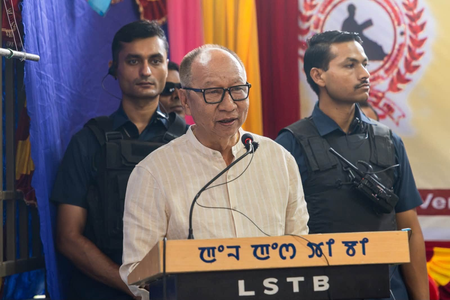
After the shocking devastation caused by floods in Nepal, Bhishma Raj Angdembe, leader of the main Opposition Nepali Congress, met Prime Minister Balendra Shah and submitted recommendations for rescue and relief. He also praised the Nepal Army for its rescue efforts. The opposition leader even pledged support to the government in responding to the disaster.
Does a similar political exercise happen in India? Does the Leader of Opposition offer suggestions and recommendations, or is the role largely reduced to opposing the government on almost everything?
The answers are not difficult to gauge. A vibrant opposition is essential for any democracy. It has to question the government, criticise its policies, hold it accountable and prevent the abuse of power. It is also expected to act as a check to ensure that governance remains transparent and responsive to people.
These rules sound rather academic when one looks at the kind of opposition politics that has played out in India over the past decade.
In Parliament, questions are often lost in disruptions. Session after session witnesses ruckus, protests and adjournments, leaving little time for meaningful debate. The problem has become more visible since the NDA government’s second term. Even in the current 18th Lok Sabha, many new MPs have struggled to get an opportunity to speak, let alone raise questions.
When a journalist recently asked Rahul Gandhi about the Opposition’s continued disruption in Parliament, the Congress leader dismissed the question by saying the journalist was a BJP person. This was hardly the first time he has reacted this way to an uncomfortable question. Reporters asking pointed questions have often been labelled as being close to the ruling party. Recently, when a reporter asked him about the families of Delhi Police personnel injured during protests at Jantar Mantar, his response again was: “Are you from BJP?”
The question is not whether journalists should be critical or whether Rahul Gandhi should be questioned. The question is whether every uncomfortable question has to be dismissed by attaching a political label to the person asking it.
Earlier, during the Budget Session in February, Gandhi displayed an alleged copy of former Army Chief General M.M. Naravane’s unpublished memoir and raised claims based on it. The episode created a ruckus in the House and led to repeated adjournments. The claims surrounding the memoir were subsequently disputed, while Naravane and the publisher clarified that the memoir had not been published. But by then, valuable parliamentary time had already been lost.
This time too, during the Monsoon Session, the Opposition led by Rahul Gandhi strongly raised the paper leak issue and the alleged crackdown on protesting students. There was nothing wrong in raising either issue. In fact, it was the Opposition’s responsibility to question the government. But should that responsibility end with raising the issue only? Shouldn’t the Opposition also suggest a counter-plan that can put the government on real notice and, more importantly, help fix the problem?
Raising one’s voice is important. But when the main issue gets drowned in the din, the Opposition’s activism hardly serves any purpose.
And then the noise ebbs, and a new issue takes its place. The problem is not Opposition or the eagerness to oppose. The problem is Opposition without proposition.
Opposition for raising noise, grabbing social media views and generating clicks — that seems to be what the role is increasingly being reduced to. Just as a reel creates a short entertaining moment, the Opposition too appears to have discovered a hit-and-run strategy.
With social media reaching almost every age group, the Opposition, particularly the Rahul Gandhi-led Congress, appears to be increasingly conscious of staying visible and relevant to younger voters. Political messaging today has to be social-media friendly. But when politics starts being designed primarily for the next clip, the larger issue can easily get lost.
This appeared to be the case when Rahul Gandhi staged a spectacular protest near the Prime Minister’s residence, an episode that quickly travelled across social media and generated views and clicks. A protest is an important democratic tool. But when the spectacle begins to overshadow the issue, the purpose gets diluted.
Since the NDA came to power in 2014, the Opposition, largely led by Rahul Gandhi, has been on an overdrive attacking Prime Minister Narendra Modi politically and, at times, personally. Political attacks are part of the game. But some attacks become so personal that they begin to cross the fine line between political opposition and political negativity.
Recently, during an event, Rahul Gandhi criticised PM Modi’s foreign policy approach and mocked his tendency to hug foreign leaders. He then hugged Congress leader Sandeep Dikshit on stage, who jokingly asked whether Gandhi was thinking of “Meloni”. Gandhi replied, “I have not reached there yet.” The remark immediately became controversial, with critics arguing that an LoP should exercise greater caution, particularly when referring to a woman head of a foreign state.
The bigger question is not whether political humour should be allowed. It is whether every political disagreement needs to be turned into a personal jab.
The same question arose during Operation Sindoor. Rahul Gandhi questioned the government over the military operation and asked, “How many Indian aircraft did we lose because Pakistan knew?” Gandhi’s question was directed at the government, as opposition questions often are. But at a time when Pakistan was pushing its own narrative about Indian aircraft losses, the timing and nature of such questions drew criticism.
The Opposition has every right to question its government, even during difficult times. But national interest also demands that political differences do not become a convenient vehicle for an adversary’s narrative.
This is where the Nepal example becomes interesting.
Bhishma Raj Angdembe did not stop being the opposition leader when Nepal faced a devastating flood. He inspected affected areas, met the Prime Minister, submitted a nine-point memorandum, and praised the Nepal Army’s rescue efforts. He did not surrender his role as an opposition leader. He recognised that there are moments when politics has to step aside, and the larger interest has to come first.
India’s Opposition does not need to stop opposing. It needs to rediscover the purpose of Opposition.
The country has enough issues — unemployment, corruption, examination irregularities, social and other concerns — for the Opposition to question the government every single day. But questioning should be followed by alternatives. Criticism should lead to solutions, and protest should lead to a conversation.
If opposing becomes a personal agenda and noise becomes the strategy, the real issue gets blurred. A protest can generate headlines, a reel can generate views, and a sharp attack can generate applause. But none of these, by themselves, can help better governance.
Perhaps the lesson from Nepal is a simple one. An opposition leader does not become less of an opposition leader by helping the government during a crisis. He may, in fact, become a better one.
India needs an opposition that questions the government, certainly. But it also needs one that knows when to offer a solution, when to cooperate and when to put the country before the next headline.
(Deepika Bhan can be contacted at deepika.b@ians.in)
–IANS
dpb/sd/
About the Author