United Nations, Oct 2 (IANS) Diplomats from across the world invoked the message of Mahatma Gandhi on his birth anniversary to address contemporary global challenges, recalling how his ideals had resonated in their respective regions.
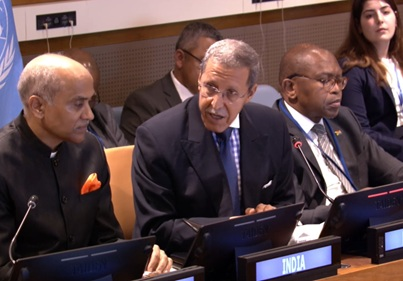
Morocco’s Permanent Representative Omar Hilale said at a commemoration of the International Day of Non-Violence here: “The international community, by celebrating the International Day of Non-Violence on his birthday, has chosen to make his legacy a common inheritance for all peoples.”
“Non-violence, in his understanding, is an active force. It demands discipline, courage and an unshakable faith in the humanity of the other,” he said.
Hilale added that in Morocco, where “faiths and cultures meet and live together”, King Mohammed VI has followed a path of “moderation, tolerance and peaceful dialogue”.
India’s Permanent Representative P. Harish cited a contemporary example of the practical application of Gandhian principles, referring to wounded pilot Smit Machchhar saving the lives of passengers on a Flydubai Airlines flight through ahimsa.
He recalled that Prime Minister Narendra Modi had said the pilot “represented a true embodiment of the principle of ahimsa or non-violence”.
Harish said PM Modi had noted that although the pilot was under attack, he “not only endured but showed bravery and courage in ensuring that the flight reached a safe destination, and all the passengers under his charge were safe and sound”.
Despite suffering stab wounds, Machchhar opened the cockpit door to allow passengers to overpower the co-pilot who had attacked him in an apparent terror hijacking attempt.
The General Assembly declared Gandhi Jayanti on Oct 2 as the International Day of Non-Violence through a resolution sponsored by 141 countries in 2007.
Before the commemoration event, Harish placed flowers at the statue of Gandhi in the UN complex.
Uruguay’s Permanent Representative Laura Dupuy Lasserre reflected on how Gandhi’s message had been applied in South America.
She said it remained relevant “in Argentina and Uruguay at times of dictatorship, with the humanitarian plight of grandmothers looking for their forcibly disappeared children and grandchildren”.
In countries in Latin America scarred by brutal dictatorships, mothers and grandmothers have peacefully demonstrated to learn the fate of their loved ones who were taken away by military regimes and never heard from again, while also advocating for human rights.
“Gandhi demonstrated that non-violence is not a sign of weakness or passivity, but an expression of courage,” said Lasserre, who is also the chair of the G77, the group of developing countries, at the UN.
South Africa’s Permanent Representative Mxolisi Sizo Nkosi said that for his country, “the principles of non-violence and peaceful coexistence resonate deeply with our own historical journey from apartheid to constitutional democracy”.
He said Mahatma Gandhi’s philosophy of Satyagraha, insistence on truth, and non-violent resistance, forged during his 21 years in South Africa, laid the foundation for mass defiance and later shaped the broader South African liberation struggle against apartheid.
The African National Congress (ANC), he said, absorbed Gandhian non-violent principles early in its history.
“Early leaders looked to Gandhi’s successful mobilisation of the Indian community through strikes, mass marches and voluntary jail attendance as a blueprint for fighting racial legislation,” he added.
Nkosi said Chief Albert Luthuli, the first ANC president to receive the Nobel Peace Prize, “was a deeply committed adherent of Satyagraha”.
For Russia’s Deputy Permanent Representative Maria Zabolotskaya, Gandhi’s role as an anti-colonial leader carried special significance.
“He was a leader of anti-colonialism, and this is important because our country always supported the anti-colonial struggle,” she said, adding that such struggles were conducted through various means and approaches.
She also recalled Gandhi’s connection with Leo Tolstoy, the Russian writer and philosopher who advocated non-violence.
Gandhi corresponded with Tolstoy, she noted.
When Indian revolutionary leader Taraknath Das wrote to Tolstoy seeking advice, the Russian philosopher replied: “Do not resist evil, but also do not yourselves participate in evil,” she recalled.
Zabolotskaya said Gandhi later sought permission to reprint the letter in his publication in South Africa and regarded Tolstoy as a teacher and an inspiration on his path.
–IANS
al/ksk/dan
About the Author