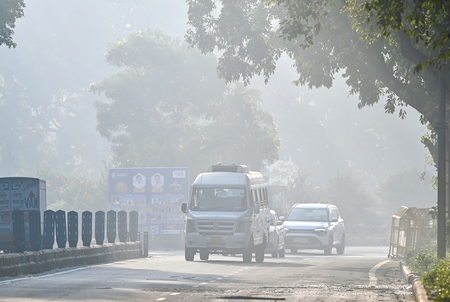
New Delhi, Oct 23 (IANS) Air pollution continued to be a concern across Delhi-NCR on Friday, with the Air Quality Index (AQI) remaining in the ‘poor’ category as temperatures gradually decline ahead of winter. The deteriorating air quality has renewed concerns about the health risks associated with prolonged exposure to polluted air.
According to data released by the Central Pollution Control Board (CPCB), several monitoring stations across the national capital recorded AQI readings in the poor category. The readings included 215 in Burari, 183 in Jharoda Kalan, 182 in Vasundhara Enclave, 161 in Ghummanhera, 170 in Uttam Nagar, 241 in NIH Narela, 263 at Mandir Marg, 232 in Aya Nagar, 275 in Punjabi Bagh, 269 at CRRI Mathura Road, 289 at Pusa, 274 in Sirifort, 206 at NSIT Dwarka, 249 at Commonwealth Sports Complex, 238 at JNU and 246 at Burari Crossing.
Other monitoring stations also reported elevated pollution levels, including Alipur (260), R.K. Puram (281), NSUT Jaffarpur (267), Dwarka Sector 8 (268), Anand Vihar (218), DTU (276), Mundka (266), Najafgarh (255), Jahangirpuri (284), Rohini (281), Jawaharlal Nehru Stadium (261), Patparganj (264), Bawana (269) and Narela (273).
The minimum temperature in Delhi-NCR is expected to remain around 19 degrees Celsius, while the maximum is likely to hover around 32 degrees Celsius.
Delhi recorded its first ‘poor’ air quality day of the season on October 21, when the AQI climbed to 245, its highest level in around 100 days. The deterioration followed Dussehra celebrations across the national capital and coincided with reports of stubble burning in neighbouring states, including Punjab, Haryana and Uttar Pradesh.
Crackers were also burst in several parts of Delhi during the festivities, alongside the traditional burning of Ravana effigies. However, no direct link has been established between the celebrations and the subsequent decline in air quality.
In response to the worsening pollution, authorities invoked Stage I of the Graded Response Action Plan (GRAP), intensifying measures to control dust and address local sources of emissions. The restrictions are particularly significant given the potential health impacts of prolonged exposure to polluted air, especially for children and senior citizens.
Under GRAP, Stage I measures apply when the AQI falls between 201 and 300, classified as ‘poor’. Stage II is implemented at AQI levels of 301-400 (‘very poor’), Stage III at 401-450 (‘severe’) and Stage IV when the AQI exceeds 450 (‘severe plus’).
Delhi Environment Minister Manjinder Singh Sirsa said the implementation of GRAP this late in the season was unprecedented in recent years.
He said the government was pursuing short-term and long-term strategies to combat pollution, with public participation and coordination between the Centre and the Delhi government forming key components of the effort.
Sirsa said an 11-point action plan was being implemented, focusing on dust control, promotion of electric vehicles, curbs on vehicular emissions and the identification of local pollution sources.
An Integrated Command and Control Centre (ICCC) has also been established to monitor pollution caused by construction activities. In addition, an artificial intelligence-based traffic management system is being used to improve traffic flow and help reduce vehicular emissions.
–IANS
jk/dpb
About the Author