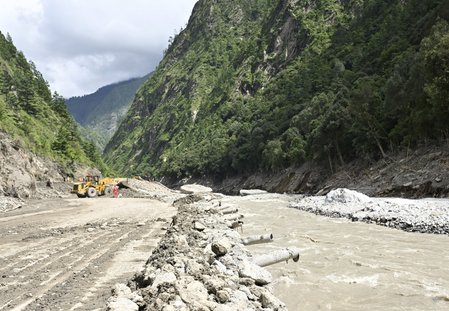
New Delhi, Aug 31 (IANS) The gushing cascade of water and sludge last week not only devastated the Nepal-China border areas, affecting Kathmandu’s trade and tourism, but may have also caused an impediment to Beijing’s aim of expanding trade to South Asia through this route in the future.
For China, the border offered a possibility of connecting trade to Bihar and Uttar Pradesh in India, with further access to Bangladesh.
When a Nepal-China border upgrade was announced, officials in Beijing had said that trade with third countries could also be done through this route in the future “if there was agreement with a third country willing to sign separate agreements”, according to popular Nepali news site Kantipur on Monday.
The Rasuwa-Kerung transit point had emerged as the “lifeline of trade” between Nepal and China after the 2015 devastating earthquake had caused massive damage to various sections of the Araniko Highway, it added.
The 114-km highway connects Nepal to China, and was completed in 1967. Its construction began under the then King Mahendra, reportedly with Chinese assistance.
Now, Nepal’s northern trade routes are disrupted by landslides and floods each year during the monsoon, blocking roads, washing away bridges, and bringing cargo movement with China to a near halt, according to a Kathmandu Post report barely days before this deluge.
The problem has persisted for nearly a decade, and this year is no different, stated the report earlier this month.
Though China had assured to upgrade the border point and the vulnerable sections of the highway under its ambitious Belt and Road Initiative (BRI), some reports suggest not much has happened.
Even after the 2024 floods and landslides, two major land routes through Kerung and Tatopani had to be closed for over a month before bilateral trade reopened at the end of October. This year, the Tatopani point also remained completely closed because of landslides along the Tatopani-Bahrabise section, according to reports.
These reports termed such closures being “hardly an isolated event”, adding that for about a decade, the road has been hit by landslides “of varying severity almost every monsoon, cutting off the border for weeks or months”.
According to Monday’s Kantipur report, Rasuwa-Kerung came into operation end-2014 where its strategic importance increased after an earthquake the following year.
“Tatopani in Sindhupalchowk, another major northern trade point of Nepal, lies on the Araniko Highway. The Tatopani border point remained closed for years after the earthquake badly damaged several sections of the Araniko Highway. Although it came into limited operation later, it did not regain its importance as a major land route between Nepal and Tibet,” it stated.
Since then, Rasuwagadhi became the main trade point for Nepal with China, with trucks carrying clothes, electrical appliances, vehicles, machinery and daily essentials starting to come to Kathmandu through the narrow gorge of the Bhotekoshi River, added the report.
Last week’s widespread inundation has been attributed to an ice and rock avalanche having triggered the Bhotekoshi flood. Thus, Beijing’s ambition to expand land trade with India and Bangladesh through Nepal has been severely disrupted by the catastrophic floods.
The disaster highlighted the fragility of Himalayan infrastructure and ironically raised concerns about China’s massive dam-building projects in Tibet, which directly affect downstream nations. While Beijing has invested heavily in Nepal-border infrastructure in order to use it as a corridor to further access, experts have blamed China’s mega dam project for posing massive damage to human life, ecology, and security in the Hindu Kush Himalaya (HKH) region.
Its mega dam at Medog in Tibet, with a planned 60,000 MW capacity, raises fears of seismic risks and downstream flooding. Now, the current situation leading to a trade disruption, China’s plans to use Nepal as a land bridge to South Asia face delays and heightened scepticism.
–IANS
jb/vd
About the Author