
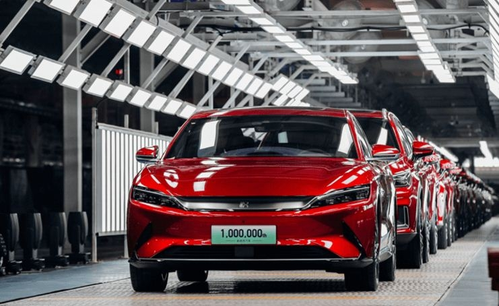
New Delhi, July 16 (IANS) China’s auto company BYD has gained top spot in global electric‑vehicle market through its alleged “pirate business model”, prompting concern in Europe and North America about the implications for domestic auto industries, a new report has claimed.
The report from European media house Politico claimed BYD sold about 4.6 million vehicles in 2025, including 2.26 million pure battery-electric cars, surpassing Tesla’s roughly 1.6 million deliveries.
The report found that BYD and other Chinese automakers are gaining market share in Europe, allegedly putting pressure on legacy manufacturers such as Volkswagen, Mercedes‑Benz and BMW.
“This will not end well unless the West unites. BYD is not just another automaker — it is a pirate ship with a balance sheet, weakening both Europe’s and America’s industrial bases, one cheap EV at a time,” the report warned.
It described BYD’s rise as the result of a business model based on piracy which relied on “copy, absorb, subsidise, scale, dump and dominate” strategy.
The company’s early models were a copy of Japanese automaker designs, and BYD then moved to produce batteries, motors, electronics, powertrains and semiconductors in‑house through reverse engineering, the report alleged.
Such a vertical integration, combined with state support and access to China’s vast market, has helped BYD expand quickly into Europe and other regions.
China offered foreign automakers “access to its vast consumer market through joint ventures and the devil’s bargain of forced technology transfer.”
“Volkswagen’s China earnings have fallen more than 80 percent over the past decade. It will cut 35,000 German jobs by 2030. It is also considering four factory closures in Germany and as many as 1 lakh job cuts worldwide — a restructuring once unthinkable,” the report said.
European Union officials have proposed a 17 per cent countervailing duty on Chinese electric vehicles, but the report alleged that bloc’s response shows fragmentation due to concerns related to trade and Chinese investments.
Chinese automakers are using Canada and Mexico as entry points to North America. They are waiting to build dealer networks, learn consumer preferences before regulatory access to the US market, the report said.
—IANS
aar/na
About the Author


