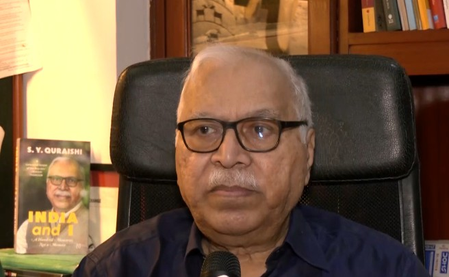
New Delhi, July 14 (IANS) Former Chief Election Commissioner (CEC) S.Y. Quraishi on Tuesday said that the Bharatiya Janata Party (BJP) was once the “strongest critic” of Electronic Voting Machines (EVMs) and had repeatedly questioned their reliability.
He also recalled that it was Telugu Desam Party (TDP) chief N. Chandrababu Naidu who proposed the introduction of the Voter Verifiable Paper Audit Trail (VVPAT), a measure that, according to him, helped restore public confidence in the EVM system.
In an exclusive interaction with IANS, Quraishi said that when he assumed office as the Chief Election Commissioner in 2010, concerns regarding EVMs were at their peak. He noted that the BJP had even published a book titled “Democracy at Risk”, highlighting issues related to the credibility and dependability of the voting machines.
Recalling the opposition to EVMs during his tenure, Quraishi said: “Oh, yes, very much. In fact, it was at the peak in our time. Even before I became CEC in 2010. The BJP was the biggest critic of EVMs, and they even wrote a book, ‘Democracy at Risk’. It was written by G.V.L Narasimha Rao with a foreword by L.K. Advani, and they were questioning the dependability and trustworthiness of the EVMs.”
Quraishi said that shortly after taking charge as Chief Election Commissioner, he convened a meeting with leaders of opposition parties to discuss their concerns regarding the electoral process. The delegation was led by N. Chandrababu Naidu, a development that initially surprised him because of Naidu’s long-standing reputation as a pro-technology leader.
“When I took over, I immediately called a meeting of all political parties, as was my norm because it’s good to discuss with them, with all the opposition parties; it was led by Chandrababu Naidu. I was initially very surprised to see him leading a delegation which is anti-technology because he was a technology icon. I told him that, and I said that ‘Chandrababu ji, tell me what your grievance and problem is; I will try and solve. And my challenge is that, at the end of the day, either you will convince me, or I’ll convince you to become the brand ambassador of EVM’.”
According to Quraishi, Naidu clarified during the discussion that he was not alleging that EVMs had been tampered with or that election outcomes had been manipulated. Instead, his concern was about the lack of visible transparency in the voting process.
“He (Naidu) said, ‘All we are saying is that there is no transparency. Meaning thereby, when you press a button, it goes into a machine; whether it is going to the right candidate or not, it’s not visible to the naked eye,” Quraishi said.
The former CEC said he then asked Naidu what solution he proposed to address those concerns. According to Quraishi, Naidu suggested introducing the Voter Verifiable Paper Audit Trail (VVPAT), which would enable voters to verify that their vote had been correctly recorded.
Explaining Naidu’s proposal, Quraishi quoted him as saying, “Introduce VVPAT, which means there will be a printer attached, and on that printer there will be a screen on which, when you choose a candidate, it will appear on the screen. So, that is how you are able to verify: yes, this is the guy I have chosen, so you can see for yourself. And after that, a chit or a slip will get cut automatically and go into a sealed box, and then you can compare the figures in the machine and the slips which it has generated.”
Quraishi said the introduction of VVPAT significantly strengthened confidence in the electoral process because the paper slips generated by the system consistently matched the votes recorded in the machines during verification exercises.
“Lakhs and lakhs of them were compared, and they all tallied. Therefore, with the help of VVPAT we were able to establish, re-establish the credibility of EVM,” he said.
Commenting on the current debate surrounding VVPAT verification, Quraishi said concerns regarding the extent of the slip counting should be addressed through dialogue rather than dismissal.
“Questions are being raised now about VVPAT, how many to be counted and all that; that’s a matter of detail, and of course we have to find a solution. If some parties and many parties in this case are questioning it, we should listen to them. Surely, just as we listened to them and found a solution. So, if you talk to them and ask them to explain what it is that they want, surely a solution will be found,” he added.
–IANS
sd/vd
About the Author