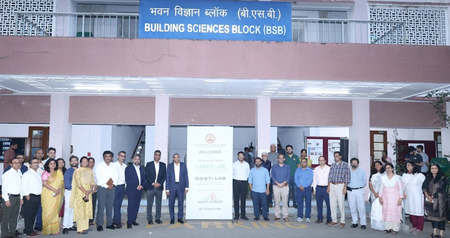
Kolkata, Nov 2 (IANS) Two advanced research laboratories focused on sustainable construction are being set up at the Indian Institute of Technology (IIT) Madras as part of a longstanding industry partnership.
The state-of-the-art research facilities will be supported by a Rs 3.8 crore grant spanning three years. The two specialised units being established are the Digital Real-Time Sensing Technologies for Infrastructure (DRSTI) and the Concrete Admixture Research for Engineering Next-gen Construction (CAREN) laboratories.
Both laboratories will be located at IIT Madras’ Centre of Excellence on Technologies for Low-carbon and Lean Construction (TLC2).
“The laboratories will focus on developing innovative solutions to improve construction productivity, material efficiency, structural durability and sustainability through next-generation materials and digital technologies,” the institute stated.
“This collaboration aims to translate cutting-edge research into practical solutions, advancing smarter infrastructure and low-carbon, lightweight construction in India,” it added.
The initiative comes at a time when sustainability and low-carbon emissions have become top priorities across the construction sector. Building material companies are actively striving to manufacture products with a significantly lower carbon footprint, encompassing everything from glass to plaster and concrete.
Under current industry developments, plaster for interior finishes is being formulated with a lower Global Warming Potential (GWP). There is also a constant effort to reduce cement clinker content for greater circularity.
Furthermore, embodied carbon in raw materials such as glass, plasterboard, and mortars is being systematically reduced, while manufacturing plants are switching to electric power and reducing the consumption of fossil fuels.
Leading industry manufacturers are expanding these efforts by maximising recycled content, reducing waste, and offering comprehensive Environmental Product Declarations (EPDs).
The broader construction sector has steadily moved from heavy to light construction, actively promoting resource-efficient designs, high thermal/acoustic insulation, and smart glass solutions that lower a building’s energy footprint throughout its operational lifecycle.
Consequently, modern offices and homes are becoming smarter through the strategic use of lighting and air-conditioning. These contemporary offices and homes are being specially designed and built with materials that have a lower carbon footprint to reduce power consumption, with many structures incorporating solar panels for the generation of green energy.
–IANS
jg/dan
About the Author