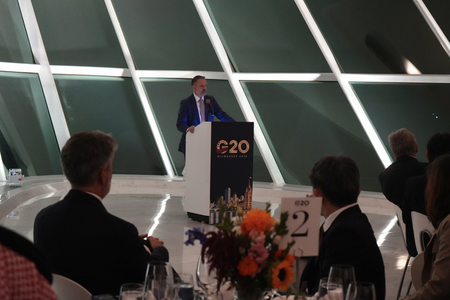
Milwaukee, Oct 3 (IANS) Discussions on global diesel supplies held on the sidelines of the G20 Trade Ministers’ meeting in Milwaukee contributed to an anticipated release of more diesel into the global market, US Trade Representative Jamieson Greer said, highlighting an energy-security outcome from the two-day gathering.
Greer, who chaired the ministerial under the US G20 presidency, disclosed the development in his statement on the outcome of the meeting, which concluded Thursday.
“We also had constructive meetings on the sidelines regarding global diesel supplies which contributed to the anticipated release of more diesel into the global market,” Greer said.
The USTR statement did not identify the countries involved in the discussions, specify the source of the additional diesel or indicate how much fuel could enter the market.
It also did not provide a timetable for the anticipated release.
The carefully worded statement stopped short of describing the move as a formal G20 agreement, saying instead that discussions on the sidelines had contributed to the expected increase in diesel supplies.
The disclosure adds an energy dimension to a ministerial largely focused on some of the most contentious issues confronting the global trading system.
Commerce and Industry Minister Piyush Goyal represented India at the meeting and held a series of bilateral discussions on its margins, including with Greer.
The two-day ministerial brought together trade ministers from the world’s major economies for discussions ranging from food security and industrial overcapacity to forced labour and reform of the Most-Favoured Nation principle.
Greer said the meeting had produced consensus among all G20 members on condemning the weaponisation of food through coercive trade actions.
“This week’s G20 Trade Ministerial in Milwaukee was a success,” Greer said.
“It is especially significant that the entire G20 was able to reach consensus on the statement on the weaponization of food through coercive trade actions,” he added.
But consensus proved more difficult on some of the other issues put forward by the United States during its G20 presidency.
The United States, Mexico and Argentina issued a separate statement on eliminating forced labour in global supply chains after the broader G20 membership failed to reach agreement on the issue.
Greer said he was disappointed by the lack of consensus but hoped discussions would continue.
“In addition, I commend Mexico and Argentina in joining the United States in a statement on eliminating forced labor in global supply chains,” Greer said.
“While I am disappointed that the G20 Trade Ministers did not reach consensus on this issue, I am hopeful that discussions on this topic will continue and that other economies will join us in taking increased action to combat forced labor in global supply chains.”
The ministers also discussed structural excess industrial capacity, another issue Washington had placed high on the Milwaukee agenda.
Greer said many G20 members showed a willingness to address excess capacity and production in sectors of concern, although some countries opposed developing a pathway for joint action.
The meeting also opened discussion on possible changes to the Most-Favoured Nation principle, a foundation of the multilateral trading system under which World Trade Organization members generally extend comparable tariff treatment to other members.
Greer said members at different levels of economic development saw merit in examining how the principle could be adapted to current global trading conditions.
The Milwaukee ministerial was held as the United States prepares to host the G20 Leaders’ Summit later this year. Washington had identified forced labour, food-related trade coercion, structural excess capacity and the MFN principle as the principal trade issues for ministerial discussion.
–IANS
lkj/rs
About the Author