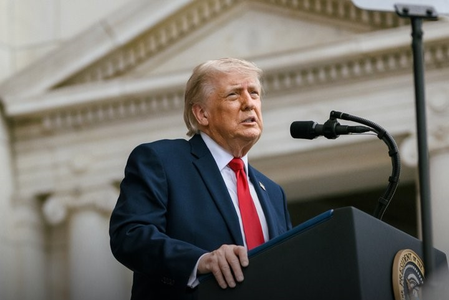
Washington, July 24 (IANS) US President Donald Trump declared that the United States was well ahead of China in the global race to dominate artificial intelligence, arguing that rapid expansion of domestic energy infrastructure was essential to maintaining that lead while ensuring American consumers do not bear the cost of powering the AI revolution.
Speaking at an event on the administration’s Ratepayer Protection Pledge, Trump said the explosive growth of AI would require more than double the country’s current electricity generation capacity and unveiled what he described as a strategy to ensure technology companies build and pay for the power infrastructure they need.
“We’re leading China by a lot,” Trump said. “And using our old grid would not have worked.”
Calling artificial intelligence “probably the biggest thing anybody’s ever seen,” Trump said the technology would reshape the global balance of power.
“I think it’s bigger than the internet. It’s bigger than anything anyone’s seen thus far,” he said. “Whoever wins that race is probably going to win, period.”
Trump said his administration had encouraged technology companies to construct their own power plants alongside AI data centres rather than relying solely on the existing electricity grid.
“You need double the electricity that we have right now, maybe even more than that, to really fulfil what you want to do,” he said.
The President argued that the approach would shield American households from higher electricity bills while accelerating investment in AI infrastructure.
“We’re insisting that AI data centres and big tech companies pay their own way,” Trump said. “They’re happy to do it, because this way, they’re going to be able to function and function brilliantly.”
According to Trump, the companies will also feed excess electricity back into the national grid.
“They’re going to have a lot of electricity left over and they’ll put that into the grid, so we’ll actually end up with more electricity, the rates are going to go down,” he said.
Trump said more than 220 utilities, technology companies, state governments and other partners had signed the administration’s Ratepayer Protection Pledge.
“Electricity rates for 80 per cent of the power distributed in America are now being kept in check by the plan,” he said.
The President repeatedly framed the initiative as part of a broader strategic competition with China.
“Again, we’re leading China and we want to keep it that way,” he said.
Trump disclosed that Chinese President Xi Jinping was expected to visit Washington later this year.
“President Xi is coming over on September 24th, and we talked about it when I was over in Beijing, and we’ll be talking about it again,” he said.
He contrasted the United States’ regulatory system with China’s approach to building power infrastructure.
“They don’t do environmental impact statements. They just say you want electric? We’ll build it,” Trump said.
Trump also warned that opposition to new AI infrastructure would benefit America’s competitors.
“Other nations are trying to get us to slow down,” he said, adding that some countries were attempting to persuade communities to reject large data-centre projects.
“They’d like to be leading the race. But we’re leading the race.”
The President said local communities hosting AI projects would benefit through investment, jobs and lower electricity costs, citing examples from several states where utilities had frozen or reduced consumer rates because of agreements linked to data-centre development.
He argued that expanding domestic energy production and AI infrastructure would strengthen both the economy and national security.
“We want to lead the world,” Trump said. “And it is said, if you come in second, you’re going to be second overall because there’s never been anything big like this.”
The rapid expansion of AI has also intensified concerns over electricity demand worldwide. Technology companies are investing billions of dollars in new data centres, prompting governments and utilities to explore ways to expand power generation while balancing energy security, affordability and climate goals.
–IANS
lkj/rs
About the Author