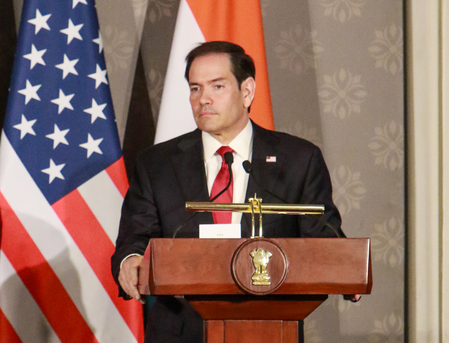
Washington, July 23 (IANS) US Secretary of State Marco Rubio on Thursday reaffirmed the Trump administration’s commitment to Southeast Asia, announcing billions of dollars in strategic investments for the region while warning that Iran’s actions in the Strait of Hormuz posed a threat to global trade and freedom of navigation.
Addressing the ASEAN Post-Ministerial Conference with the United States in Manila, Rubio said Washington viewed ASEAN as its primary mechanism for engagement in the Indo-Pacific and pledged that the partnership would remain a long-term strategic priority.
“As President Trump stated last year at the leaders meeting, the US-ASEAN, at the summit, we’re with ASEAN 100 per cent,” Rubio said. “This is the primary mechanism by which we engage the region, and you will continue to see our commitment to it at the highest levels.”
A significant portion of Rubio’s remarks focused on Iran and the Strait of Hormuz, one of the world’s busiest maritime chokepoints for oil shipments.
He said the United States remained committed to diplomacy but accused Tehran of failing to honour previous commitments despite engaging Washington through multiple channels.
“The United States is always committed to diplomacy. We are open-minded and always willing to engage in negotiated settlements of differences,” Rubio said. “Unfortunately, so far, even though we have reached agreements, they have not kept their commitments.”
Echoing President Donald Trump’s earlier remarks, Rubio said the administration questioned Iran’s seriousness about negotiations.
“If they’re serious, we’re serious. If they’re not, then we will do what is necessary to protect that, our interest and also the interests of our allies,” he said.
Rubio argued that the dispute extended beyond the Middle East and touched on a fundamental principle governing international commerce.
“At its core, it’s very simple — Iran demands the right, which they do not have under any existing legal mechanism, to control the transit of traffic through the Straits of Hormuz,” he said.
Calling the waterway an international passage, Rubio warned against allowing any country to establish control over maritime transit.
“If we create a precedent in the Middle East, where a nation state can decide that they are going to control an international waterway, charge a toll, and if you don’t pay them, blow up your ships, we have created a very dangerous precedent, which will repeat itself in other parts of the world, including in this region,” he said.
He added that freedom of navigation was essential for global economic stability.
“What is at stake here is not simply the issue of what’s happening in the Straits of Hormuz, it’s a very fundamental principle about freedom of navigation.”
Turning to regional cooperation, Rubio announced what he described as a major expansion of American economic engagement with Southeast Asia.
He said the United States would deliver $2.5 billion in US government strategic investments in Southeast Asia, describing the move as an investment in American national interests rather than foreign aid.
“This is not charity; this is not something we’re doing because we’re nice people… It’s in our national interest,” Rubio said. “Our partnership with each of your countries in the region at large is in the national interest of the United States, and we will never abandon it.”
Rubio also highlighted the recent approval of $1.5 billion in new strategic investments through the US Development Finance Corporation to support aviation infrastructure, energy, energy security and secure supply chains across the region.
He described Southeast Asia as central to the global economy’s future.
“I believe very much that the future and the story of the 21st century will be written in this region and by how events unfold here,” Rubio said.
The secretary also announced nearly $130 million in assistance for ASEAN countries to support demining programmes, while outlining continued US backing for liquefied natural gas market development, electricity grid technologies, civil nuclear energy programmes, regional energy infrastructure and critical mineral supply chains.
“The United States… stands with ASEAN,” Rubio said, adding that Washington wanted to remain “your reliable and durable partner for the next 50 years and beyond.”
The ASEAN Post-Ministerial Conference brings together the United States and the 10-member Association of Southeast Asian Nations to review cooperation on regional security, economic integration and strategic issues. The meeting comes as Washington seeks to reinforce its Indo-Pacific strategy amid intensifying geopolitical competition and growing concerns over maritime security.
–IANS
lkj/dan
About the Author