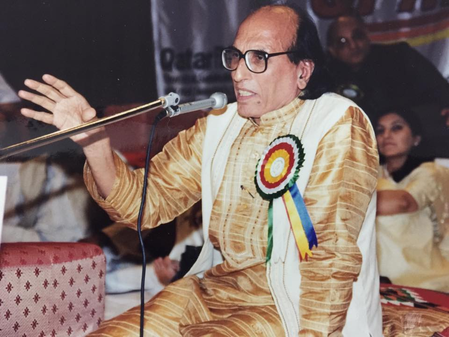
Bhopal, May 28 (IANS) Renowned Urdu poet Dr Bashir Badr, known for his expressive and evocative ‘shayri’ passed away in Bhopal on Thursday afternoon, leaving behind a rich literary legacy that spanned decades. He was 91.
He breathed his last at around 12 noon at the age of 91.
According to family members, Badr had been suffering from dementia for a long time, a condition that gradually eroded his memory and left him unable to recognise even close acquaintances. His health had been deteriorating steadily in recent months, and despite medical care, his condition worsened until his demise.
The funeral arrangements are yet to be finalised, though family sources indicated that the last rites may be performed later on Thursday only.
His passing marks the end of an era in Urdu poetry, as Badr was celebrated for his evocative verses, like “”Ujale apni yaadon ke hamare saath rahne do/Na jaane kis gali mein zindagi ki shaam ho jaaye”, or “Kai sitaron ko main jaanta hoon bachapan se/Kahin bhi jaaun mere saath saath chalte hai”, or “Sar jhukaoge to patthar devtaa ho jaayega/Itna mat chaaho use wo bewafa ho jaayegaa”, “Khuda ham ko aisi khudaai na de/Ki apne siva kuch dikhai na de”, Kuch to majbooriyan rahi hongi/Yun koi bewafa nahi hota”, and many more, that captured the complexities of love, longing, and human emotion with unmatched simplicity and depth.
His literary journey was not only prolific but also profoundly inspiring, influencing generations of readers and writers alike. A familiar figure in ‘mushairas’ across India, he was much admired for the art with which he not only recited his sparkling couplets, but frequently elaborated on their creation and his inspiration.
Born in 1935, Bashir Badr rose to prominence in the post-Independence period, becoming one of the most widely read and quoted poets in contemporary Urdu literature. His ghazals, often laced with poignant reflections on life and relationships, earned him admiration across India and beyond. He was known for bridging the gap between classical traditions and modern sensibilities, making Urdu poetry accessible to a broader audience.
His couplets, frequently shared in everyday conversations and on social platforms, remain etched in public memory. Despite his illness in later years, Badr’s contributions continued to resonate, reminding admirers of the enduring power of words. He once wrote: “Ham bhi darya hain hamen apna hunar maaluum hai/Jis taraf bhi chal padenge raasta ho jaayega”.
His decline due to dementia was a painful chapter, as the poet who once illuminated minds with his verses gradually lost his own connection to memory and recognition. Yet, his work stands as a testament to resilience and creativity, ensuring that his voice will echo long after his departure.
As the literary community mourns his loss, tributes are pouring in from writers, scholars, and admirers who regard him as a towering figure in Urdu poetry. Dr Bashir Badr’s death leaves a void that cannot be filled, but his words will continue to inspire and console countless hearts.
As he wrote: “Musafir hai ham bhi musafir ho tum bhi/Kisi mod pe phir mulaqaat hogi”.
–IANS
sktr/vd
About the Author